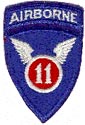
he 11th Airborne Division was activated at Camp Mackall North Carolina on
February 25, 1943 under the command of Major General Joseph M. Swing
(picture left). The division was manned primarily with former glider troops and some veteran Airborne
troops. Immediately after activation, the Division began an intensive training cycle to get all of the glider troops
jump qualified. Many of the troops were simply sent up in an aircraft with little formal training on the ground.
The new Airborne soldiers performed above expectations and the Division was ready for overseas movement barely a
year later.
In early 1944, the "Angels" were ordered to prepare for embarkation and the Division moved
to San Francisco California. They boarded troop transports and in May they were on their way to New Guinea in the
South Pacific. Upon arrival they were ordered into an intensive training cycle to learn jungle warfare in
preparation for the invasion of the Pilippines. For 5 months the 11th Airborne sweated in the jungles and mountains
of New Guinea and had several training jumps. FInally on November 11th, the Division boarded transports for their
objective.
On November 18, 1944, the Angels landed at Leyte Beach Philippines. After consolidating
their equipment, they moved inland to relieve they weary 24th Infantry and 37th Infantry Divisions. The 11th's
objective was to clear a mountain pass from Burauen to Ormoc. It took 3 months of bitter fighting, often
hand-to-hand to drive the Japanese defenders from the pass and surrounding heights. In the end the 11th Airborne
had killed almost 6,000 enemy soldiers. When the Division arrived in Ormoc they were given a much needed rest and
resupply.
On January 26, 1945 the 11th went back into action having rested only a few days. The
Division landed at Nasgubu Beach, Luzon some 70 miles from the capitol city of Manila. Their mission was simple,
clear all enemy opposition from a major highway and link up with the Allied forces attacking Manila. In just 5 days,
the Division had eliminated all enemy resistance along Highway 17 and had pierced the main line of resistance at
Tagayatay Ridge. Here the 511th Parachute Infantry Regiment conducted a combat parachute drop to reinforce the 11th
and the Division continued north.
After capturing Fort McKinley and Nichols field, the 11th launched their
assult on Manila joining the 1st Cavalry Division and the 37th Infantry Division who were attacking from the North.
Once the capitol was liberated, the 11th made a daring raid behind enemy lines and liberated 2,147 Allied POWs from
the Los Baños Internment Camp. Once that mission was cleared the 11th Airborne spent the next few weeks mopping up
resistance in the southern areas of Luzon.
In May of 1945, the Division moved into a reserve area in the Philippines to rest,
resupply and take in new troops. They began preparations for the next big operation. Operation Olympic, the
invasion of the Japanese home islands. Those plans were cancelled after the Japanese surrender in August 1945. On
Aug. 10, 1945, the division moved to Okinawa to escort Gen. Douglas MacArthur into Japan and to spearhead the
occupation. The 11th Airborne landed at Atsugi Airdrome, near Tokyo, on Aug. 30, 1945, and occupied an initial area in
and around Yokohama. They remained there until mid-September 1945, when they moved to northern Japan and assumed
responsibility for Akita, Yamagata, Miyagi and Iwate Prefectures. The division later took over control of Amori,
Hokkaido, Fukushima and Prefectures to control of almost half the island of Honshu and all the island of Hokkaido.
Legend has it that when the 1st Cavalry Division, whose motto is "1st in Manila,
1st in Tokyo" arrived in Tokyo, they were met by the 11th Airborne Division band. The band played a special
song for the Cavalry; "The old gray mare ain't what she used to be". General Swing left the
division, which he had formed and led through combat, in January 1948, to assume command of 1st Corps, 8th Army and
Maj. Gen. William M. Miley, the former commander of the 17th Airborne Division, assumed command. The 11th Airborne
Division remained on occupation duty until 1949 when they were relieved and sent to Camp Campbell Kentucky.




 he 11th Airborne Division was activated at Camp Mackall North Carolina on
February 25, 1943 under the command of Major General Joseph M. Swing
he 11th Airborne Division was activated at Camp Mackall North Carolina on
February 25, 1943 under the command of Major General Joseph M. Swing