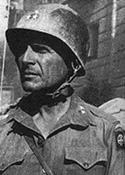
Gen Matthew B Ridgway
R E L A T E D
B I O S
Gen
Matthew B Ridgway
Gen
James M Gavin
Lt Gen Lewis H Brereton
Gen
Maxwell D Taylor
Gen
Dwight D Eisenhower
FM Bernard L Montgomery

R E L A T E D
S I T E S
US XVIII Airborne Corps
USAAF Airborne Troop Carriers in World War II
Camp Claiborne, Louisiana
ETO
Cross Channel Attack (Hyperwar)
R E L A T E D
R E S O U R C E S
The 82nd
Airborne (CMH) Center for Military History
Battle of the Bulge (CMH)
articles
R E L A T E D
A R T I C L E S
The
Decision to Launch Operation Market Garden
Personal
Rembrance of Crossing the Waal Canal
The
Ardennes: Battle of the Bulge


|
The XVIII
Airborne Corps during World War II
Overview

In August, 1944 General Matthew Ridgway the 82nd Airborne Commanding General
was promoted and took command of the newly formed XVIII Airborne Corps.
(patch: right) The U.S. XVIII Airborne Corps consisted of the 82nd, 101st and 17th Airborne
Divisions. Other units were also attached at various times. General James Gavin replaced General Ridgway as
Commander of the 82nd Airborne Division for the remainder of the war.
 ince
the inception of the Parachute Test Platoon at Fort Benning, Georgia on June 26, 1940, airborne
tactics have progressively proven to be a valuable asset to the United States (U.S.) Army. This was evident
by the success of the 82nd Airborne Division and the IX Troop Carrier Command during the Sicily and
Italian campaigns. Furthermore, the esprit de corps exhibited by the 82nd Airborne and the
101st Airborne Divisions in the critical days following the Normandy invasion ensured that airborne
tactics and maneuvers would remain an integral part of U.S. Army operations. By midsummer of 1944
it was evident to Supreme Headquarters Allied Expeditionary Force (SHAEF) that a unity of command
among airborne divisions was necessary in order to fully exploit their unique power. Correspondingly,
British Airborne and Royal Air Force units found themselves in the same position. In order to
streamline and coordinate efforts the First Allied Airborne Army (FAAA) was created under the command
of U.S. Army Lt. Gen. Lewis H Brereton (picture below right).
He immediately assumed command of all British and U.S. airborne
and Troop Carrier units in the European Theatre of Operations (ETO). This unique command structure
led to the formation of the U.S. XVIII Airborne Corps and the First British Airborne Corps. ince
the inception of the Parachute Test Platoon at Fort Benning, Georgia on June 26, 1940, airborne
tactics have progressively proven to be a valuable asset to the United States (U.S.) Army. This was evident
by the success of the 82nd Airborne Division and the IX Troop Carrier Command during the Sicily and
Italian campaigns. Furthermore, the esprit de corps exhibited by the 82nd Airborne and the
101st Airborne Divisions in the critical days following the Normandy invasion ensured that airborne
tactics and maneuvers would remain an integral part of U.S. Army operations. By midsummer of 1944
it was evident to Supreme Headquarters Allied Expeditionary Force (SHAEF) that a unity of command
among airborne divisions was necessary in order to fully exploit their unique power. Correspondingly,
British Airborne and Royal Air Force units found themselves in the same position. In order to
streamline and coordinate efforts the First Allied Airborne Army (FAAA) was created under the command
of U.S. Army Lt. Gen. Lewis H Brereton (picture below right).
He immediately assumed command of all British and U.S. airborne
and Troop Carrier units in the European Theatre of Operations (ETO). This unique command structure
led to the formation of the U.S. XVIII Airborne Corps and the First British Airborne Corps.
 On 27 August 1944, Headquarters and Headquarters Company and Headquarters and
Headquarters Battery, Corps Artillery, XVIII Corps arrived from the United States at Ogbourne St. George,
England, to learn that as of that date it had been redesignated the U.S. XVIII Airborne Corps. It was immediately
placed under the command of Maj Gen Matthew B Ridgway, who until then was the Commanding General of the 82nd
Airborne Division. Meanwhile, Assistant Division Commander, General James
Gavin was also promoted and assumed command of the 82nd Airborne.
Under Gen Ridgway's new command were the 82nd, 101st and 17th Airborne Divisions. The 82nd and 101st
Divisions were already in England after the successful completion of Operation Neptune, the airborne
operation for the invasion of Normandy. The 17th Airborne Division was in the process of disembarking
in England from the United States. It was at this time that the 507th Parachute Infantry Regiment (PIR)
which was part of the 82nd Airborne Division during Operation Neptune was permanently assigned to the
17th Airborne Division.
On 27 August 1944, Headquarters and Headquarters Company and Headquarters and
Headquarters Battery, Corps Artillery, XVIII Corps arrived from the United States at Ogbourne St. George,
England, to learn that as of that date it had been redesignated the U.S. XVIII Airborne Corps. It was immediately
placed under the command of Maj Gen Matthew B Ridgway, who until then was the Commanding General of the 82nd
Airborne Division. Meanwhile, Assistant Division Commander, General James
Gavin was also promoted and assumed command of the 82nd Airborne.
Under Gen Ridgway's new command were the 82nd, 101st and 17th Airborne Divisions. The 82nd and 101st
Divisions were already in England after the successful completion of Operation Neptune, the airborne
operation for the invasion of Normandy. The 17th Airborne Division was in the process of disembarking
in England from the United States. It was at this time that the 507th Parachute Infantry Regiment (PIR)
which was part of the 82nd Airborne Division during Operation Neptune was permanently assigned to the
17th Airborne Division.
Detailed planning for various airborne operations were already in progress
for a series of targets such as the Seine River, the areas Rambouillet - Chartres - Etampes, the area
Lille - Tourcoing - Tournai, Walcheren Island. However, in each instance the headlong dash of the Allied
armies juggernaut across France and the Lowlands rendered any airborne participation unnecessary.
Finally, as swiftly as prior targets had appeared and disappeared, came the
opportunity of the Twenty First Army Group to employ and airborne spearhead in a bold offensive through
Holland designated Operation Market Garden. Thus the stage was set for XVIII Airborne Corps initial
active participation in the ETO, a mere 20 days after arriving in the United Kingdom as a ground unit.
Operation Market Garden
This was an audacious plan concocted by British Field Marshal Montgomery (picture below left)
that would be the first major daylight air assault attempted by a military power since Germany's attack
on Crete. Similar to the Germans assault of four years earlier, the Allies initial plan for
September 17,1944 was to use the paratroopers and glidermen of the 82nd and 101st
U.S. Airborne Divisions and England's First Airborne Division in a daring daylight drop into
Holland. The airborne Allied troops were to seize roads, bridges and the key communication cities of
Eindhoven, Nijmegen and Arnhem, thus cutting Holland in half and clearing a corridor for British
armoured and motorized columns all the way to the German border. Similar to the Germans assault of four years earlier, the Allies initial plan for
September 17,1944 was to use the paratroopers and glidermen of the 82nd and 101st
U.S. Airborne Divisions and England's First Airborne Division in a daring daylight drop into
Holland. The airborne Allied troops were to seize roads, bridges and the key communication cities of
Eindhoven, Nijmegen and Arnhem, thus cutting Holland in half and clearing a corridor for British
armoured and motorized columns all the way to the German border.
Although XVIII Airborne Corps achieved their objectives the plan was
overly ambitious from a logistical standpoint and the operation did not achieve it ultimate objective.
Battle of the Bulge - The Ardennes Offensive
On 16 December 1944 the German High Command launched a daring counter-offensive
against the First and Third U.S. Armies in the Ardennes, Belgium. Initially, the enemy offensive met with
considerable success, and only through the heroic efforts of numerous American units were the Germans
stopped and then pushed back.
The 82nd and 101st Airborne Divisions had recently disengaged from operations
in Holland and were training and refitting in base camps in the Reims-Suippes-Sissonne area of France.
The 17th Airborne Division was in training at base camps in Wiltshire and Surrey, England. Corps
Headquarters and Corps troops were split between Epernay, France and Ogbourne St. George, England.
The initial success of the enemy counter-offensive resulted in a decision by
General Eisenhower, Supreme Commander, SHAEF to detach the XVIII Airborne Corps from the FAAA and attach
it to the Twelfth Army Group. Meanwhile, concurrent action had been taken to move the 82nd and 101st
Airborne Divisions by truck to the vicinity of Bastogne, Belgium which was the concentration area
assigned by the First U.S. Army. Poor weather conditions initially kept the 17th Airborne Division in
England. However, they were later able to fly into action from England and fought under the
Third U.S. Army.
Through the superb initiative and cooperation of the Communication Zone
particularly OISE Base Section, the 82nd and 101st Airborne Divisionswere assembled, rationed, supplied
with ammunition and cleared from their base areas in approximately eighteen hours. While enroute to the
front, orders were received attaching the 101st Airborne Division to the VIII Corps in the Bastogne area,
directing the remaining XVIII Airborne Corps Headquarters and the 82nd Airborne Division to proceed into
action in the vicinity of Werbomont, Belgium.
Because the Ardennes Mountains form a rugged broken terrain with the weather
and visibility poor, the fight became a battle for roads as the German avalanche poured westward.
Since the American lines between Malmedy on the north and Bastogne on the south were already broken,
the Germans sought to press their advantage westward toward Paris and northward to capture huge
American stores, particularly gasoline at Verviers and Liege. To accomplish these objectives the Germans
it was imperative to force the salient to open wider at Malmedy and Bastogne.
The XVIII Airborne Corps mission was to first halt the onrushing German Armor
Columns and then expel the Germans from the northern part of the salient. The three key road centers
were St. Vith, tenaciously held by the 7th Armored Division and reinforced by elements of the
9th Armored and the 106th and 28th Infantry Divisions; Houffalize, already in enemy hands; and Bastogne
which the 101st Airborne Division never allowed to be captured.
The 30th Infantry Division with elements of the 3rd Armored Division were in a
deadlock with the German 1st SS Panzer Division around Malmedy in the west. Meanwhile, there was no contact
between the 7th Armored Division and the 30th Infantry Division. It was through this gap that the Germans
were pushing their armored columns westward to strike through St. Vith with overwhelming force, then whip
around the exposed right flank of the 7th Armored Division.
The 82nd Airborne Division was immediately thrown into this gap and commenced attacking at once.
By midnight of December 20th, 1944 the 82nd had established a bridgehead over the Salm River at Trois Ponts.
Contact was finally established with all elements of the XVIII Airborne Corps and the 84th Infantry
Division was tenatively attached.
By December 23rd the situation became extremely critical. The positions befrore St. Vith were
no longer tenable. the 7th Armoreed with elements of the 106th and 28th Infantry Divisions were withdrawn
and given defensive positions on the Corps right. The 84th Infantry Divison was committed to shoring up the
the north side of the salient as the Germans made an all out effort to break through the Corps front
lines to Verviers and Liege.
 December 24th found the 82nd Airborne Division dangerously out in front of a jagged
irregular front line. To shorten the line the division was ordered to withdraw and did so under the cover
of darkness. The following days marked the turning pont and the high tide of enemy operations. Seeking
desperately to pierce the American defenses, the Germans continually attacked northward with especially
heavy fighting at the critical road center of Manahay. Every attacked was repulsed and the line held. December 24th found the 82nd Airborne Division dangerously out in front of a jagged
irregular front line. To shorten the line the division was ordered to withdraw and did so under the cover
of darkness. The following days marked the turning pont and the high tide of enemy operations. Seeking
desperately to pierce the American defenses, the Germans continually attacked northward with especially
heavy fighting at the critical road center of Manahay. Every attacked was repulsed and the line held.
(Picture above right: The 504th PIR of the 82nd Airborne Division move up to Herresbach through the woods - 28 January 1945 )
Operation Varsity - The Airborne Assault on the Rhine
In early February 1945, the tide of battle was such as to enable an accurate estimate as
to when and where the 2nd British Army would be ready to force a crossing of the Rhine River. It was
determined that the crossing would be in conjunction with an airborne operation by XVIII Airborne Corps.
The sector selected for the assault was in the vicinity of Wesel, just north of the Ruhr, on
24 March 1945. Operation Varsity would be the last full scale airborne drop of World War II and the
assignment went to the British 6th Airborne Division and the 17th Airborne Division with the 507th
spearheading the assault dropping at the southern edge of the Diersfordter Forest, three mile northwest of
Wesel.
24 March, 1945 dawned hazy over the drop and landing zones. It had not cleared to any great
extent when the two converging air columns roared across the Rhine at 1000 hours. Enemy flak took a
heavy toll but not a pilot faltered. By noon, the two airborne divisions were on the ground.
The impact of the vertical envelopment was tremendous. The result was a complete break-through
of the German Rhine defenses in this area. By mid afternoon of D-Day, all Corps objectives, including
bridgeheads across the Issel River, had been captured, the Corps Commander had crossed and assumed command,
and firm contact had been established with 12 British Corps.
Exploitation of the gap torn through the enemy positions was relentless and decisive during the
next five days. During the six day period, 24 to 30 March, in which the Corps was operational, it averaged a
daily advance of over seven miles, took 8,000 prisoners, destroyed the 84th German Infantry Division and
captured or destroyed 124 artillery and AA pieces and 26 tanks.
This relatively small operation, by a single Corps, imparted a momentum which was maintained
through the Ruhr pocket during April, 1945, substantially unchecked, until the Baltic was reached and the
war ended.
On May 7, 1945, General Alfred Jodl signed the instrument of surrender in Rheims, France.
The ceremony was repeated the next day in Berlin for the benefit of the Russians and President Truman
declared May 8 as V-E Day.
( Source: "Mission Accomplished: XVIII Corps (Airborne) in the ETO" (
XVIII Corps - Donna Tabor))
books
R E L A T E D B O O K S
Alexander, Larry Biggest Brother: The Life of Major Dick Winters, The Man Who Led the Band of Brothers NAL Hardback (April 2005), 320 p. ISBN: 0451215109
Ambrose, Stephen E Band of Brothers:
E Company, 506th Regiment, 101st Airborne from Normandy to Hitler's Eagle's Nest.
Simon & Schuster, (June 2001) 336 p. ISBN: 0-743-21638-5
Ambrose, Stephen E Citizen Soldiers:
The U.S. Army from the Normandy Beaches to the Bulge to the Surrender of Germany, June 7, 1944-May 7, 1945.
Simon & Schuster, (Nov 1997) 528 p. ISBN: 0-684-81525-7
Annussek, Greg Hitler's Raid to Save Mussolini: The Most Infamous Commando Operation of World War II. Sept 1, 2005, Da Capo Press, 353 pp. ISBN: 0306813963
Archer, Clark Paratroopers
Odyssey : A History of the 517th Parachute Combat Team. 266p., 1985, ISBN: 0961601507
Astor, Gerald 'Battling
Buzzards': The Odyssey of the 517th Parachute Regimental Combat Team 1943-1945. 338p.,
7/93, Donald I Fine Pub, ISBN: 0440236932
Badsey, Stephen & Chandler, David G (Editor)
Arnhem 1944:
Operation "Market Garden" (Campaign No.24) 1993 96p. ISBN: 1855323028
Bando, Mark A Avenging Eagles: Forbidden tales of the 101st Airborne in World War 2. Bando Publishing, (2006) 183 p.
ISBN: 0977911705
Bando, Mark A 101st Airborne: The Screaming Eagles at Normandy. Zenith Press, (Apr 2001) 156 p.
ISBN: 0760308551
Bando, Mark A Vanguard of the Crusade:
The US 101st Airborne Division in WW II. The Aberjona Press, (June 2003) 320 p.
ISBN: 0971765006
Blair, Jr, Clay Ridgway's Paratroopers:
The American Airborne in WW II. New York: Doubleday, 1985 588 p. ISBN: 0385278888
Bowen, Robert 101st Airborne:
The Screaming Eagles at Normandy. Motorbooks International, (April 15,2001) 156 p. ISBN: 1853674656
Bradley, James Flags of Our Fathers Bantam (May 2,2000), 384 p.
ISBN: 0553111337
Breuer, William B Geronimo! American
Paratroopers in WWII. New York: St. Martin Press, (1989) 621 p.
ISBN: 0-312-03350-8
Breuer, William B Operation Dragoon:
The Allied Invasion of the South of France. Presidio Press, Sept 1987 261 p. ISBN: 0891413073
Breuer, William B Unexplained
Mysteries of World War II. John Wiley & Sons, Sept 1998 256 p. ISBN:0471291072
Burgett, Donald R Currahee!.
Presidio Press, (Sept 1999) 256 p. ISBN: 0-891-41681-1
Burriss, T Moffatt
Strike and Hold: A Memoir of the 82nd Airborne in WW II Brasseys, Inc, 256 pp August,2000 ISBN: 1574882589
D'Este, Carlonbsp;
Decision in Normandy William S Konnecky Assc(P), 560 p. ISBN: 1568522606
D'Este, Carlo
Patton: A Genius for War 1024 pp ISBN: 0060927623
De Trez, Michel
The Way We Were: "Doc" Daniel B. McIlvoy: Regimental Surgeon, 505 Parachute Infantry Regiment, 82nd Airborne Division (WW II American Paratroopers Portrait Series)
August 20, 2004, D-Day Pub, 167 p. ISBN: 2960017668
De Trez, Michel
Colonel Bob Piper: G Company 505 PIR (WW II American Paratroopers Portrait Series)
March, 2003, D-Day Pub, 48 p. ISBN: 2960017641
Falerios, Kenton J.
Give Me Something I Can't Do: The History of the 82nd Military Police Company, WW 1 to Iraq
Nov 2007, Authorhouse, 192 p ISBN: 1434337197
Francois, Dominique 507th Parachute Infantry Regiment: A Forgotten Regiment Heimdal (Aug 2002), 120 p. ISBN: 2840481642
Gabel, Kurt The Making of a Paratrooper: Airborne Training and Combat in World War II Univ Press of Kansas (Jan 1990), 282 p. ISBN: 070060409X
Gassend, Jean-Loup Operation Dragoon: Autopsy of a Battle: The Allied Liberation of the French Riviera August-September 1944 Schiffer Publishing, Ltd. (May 28, 2014), 560 p. ISBN: 076434580X
Gavin, James M.
On to Berlin : Battles of an Airborne Commander, 1943-1946 ISBN: 0670525170
Giard, Régis & Frédéric Blais Helmets of the ETO: A Historical & Technical Guide Histoire & Collections (Jan 2008), 216 p. ISBN: 2352500621
Hastings, Max Overlord: D-Day and the Battle for Normandy Simon and Shuster(JUV), 396 p.
ISBN: 0671554352
Hicks, Anne The Last Fighting General: The Biography of Robert Tryon Frederick Schiffer Pub Ltd, 320pp, ISBN: 0764324306
Inglesby, Leo C A Corporal Once Xlibris
2/2/2001, 108 p. ISBN: 0738838209
Keegan, John The Second World War Penguin
(P), 708 p. ISBN: 014011341X
Keegan, John Six Armies in Normandy: From D-Day to the Liberation of Paris Penguin USA(P), 365 p.
ISBN: 0140235426
Kershaw, Alex The Longest Winter: The Battle of the Bulge and the Epic Story of WWII's Most Decorated Platoon
Da Capo Press, 288 pp November 30, 2004 ISBN: 0306813041
Kormann, John G Echoes of a Distant Clarion: Recollections of a Diplomat and Soldier Vellum
(P), 520 p. ISBN: 0979448832
Koskimaki, George E D-Day With The Screaming Eagles
Casemate Publishers and Book Distributors, 356 pp September 11, 2002 ISBN: 1932033025
Koskimaki, George E Hell's Highway: Chronicle of the 101st Airborne Division in Holland, September-November 1944
Casemate Publishers and Book Distributors, 453 pp March 1, 2003 ISBN: 193203305X
Koskimaki, George E The Battered Bastards of Bastogne: A Chronicle of the Defense of Bastogne, December 19, 1944 - January 17, 1945
Casemate Publishers and Book Distributors, 484 pp December 1, 2002 ISBN: 1932033068
MacDonald, Charles B A Time For
Trumpets: The Untold Story of the Battle of the Bulge Wm Morrow & Co
(P), 720 p. ISBN: 068151574
Megallas , James All the Way to Berlin:
A Paratrooper at War in Europe 336p., Presidio Press, March, 2003. ISBN: 0891417842
Messina , Phillip Anzio: Song of
Destiny A.G.Halldin Publishing Company, 1992. ISBN: 0 935 64838 0
Nigl, Dr Alfred J & Charles A Nigl
Silent Wings - Savage Death Santa Ana, CA: Graphic Publishing, Dec 3,2007. 288 p. ISBN: 1882824318
O'Donnell, Patrick K. Beyond Valor
Free Press, 2001, 384 p. ISBN: 0684873842
Orafalea, Gregory
Messengers of the Lost Battalion : The Heroic 551st and the Turning of the Tide at the Battle of the Bulge Free Press, March 14,1997. 432 p. ISBN: 068 482 804 9
Post, Robyn, Guarnere, William & Heffron, Edward
Brothers in Battle, Best of Friends
Berkley Hardcover, 10/2/2007. 320 p. ISBN: 0425217280
Ryan, Cornelius
The Longest Day Touchstone Books (P), 350 p. ISBN: 0671890913
Ryan, Cornelius
A Bridge Too Far 670p. ISBN: 0684803305
Tomedi, Rudy Ridgeway: A Biography of One of America's Greatest Generals William Morrow & Company, 320 p.
ISBN: 068816207X
The Center of Military History
The War in the Mediterranean: A WWII Pictorial History Brasseys, Inc.,
465 p. ISBN:1574881302
van Lunteren, Frank The Battle of Bridges: The 504th Parachute Infantry Regiment in Operation Market Garden Casemate, June 1,2014. 336 p. ISBN: 1612002323
Verier, Mike
82nd Airborne Division in
Colour Photographs (Europa Militaria, No 9) ISBN: 187 200 4857
Wildman, John B All Americans 82nd
Airborne. Meadowlands Militaria, 6/83 ISBN:091 208 1007
Yardley, Doyle R
Home Was Never Like This. Yardley Enterprises, Aug, 2002, 312 p. ISBN:0971743908
|